
SWOT Analysis is a tool for recognition internal strength and weakness as well as external opportunities and threats. When the internal environment matches with external environment, it is called strategic fit. So, identification of SWOT is significant to determine later steps of the strategy.
SWOT is generally used for companies, but it is very wide usage. SWOT Analysis can be a guide even for our own lives. In this essay, I will do SWOT Analysis for a brand, Nestle, and also one of its product, KitKat.
NESTLE
Strength: Firstly, Nestle has highly diversified company; it operates in many different countries and include many different product group. The variation in product group enable Nestle to reach many people. And customized products are launched to satisfy customer needs and wants. In addition, Nestle consist of many well-known brands, it is umbrella brand. As a result, customers rely on and loyal to the brand, which is too hard to get. So expansive product portfolio is one strength it has. Another one is having reputed brand name. Nestle is 66. company in the Fortune Global 500 (2017). So, it is even known before entering a new market. The brand name itself is a strength. Third one is their research and development activities. According to its official website, “Nestle has the world’s largest food and nutrition research organization with about 5000 people working in R&D as well as corporate venture and research partnership with businesses and universities”(2017). Last strength is its developed distribution channels. Because Nestle sells its product in 191 country (2017) over the world, this provides it strong distribution channels almost all over the world.
Weakness: Being umbrella company may have drawbacks as well as the benefits mentioned before. It creates problem in case of conflict of interest, so brand structure could be a weakness for the company. Another weakness is child labors were used in cacao plantation where Nestle supplies its cacao. About that issue, there is a lawsuit against Nestle, the lawsuit dismissed to conclude that company cannot be liable for this violation; however Nestle doesn’t take any action to improve the working condition of these children. Another issue is Nestle still has opponent group due to its historical background. In 1970s, Nestle’s baby food which is shown in Figure 1, was resulted with huge boycott.

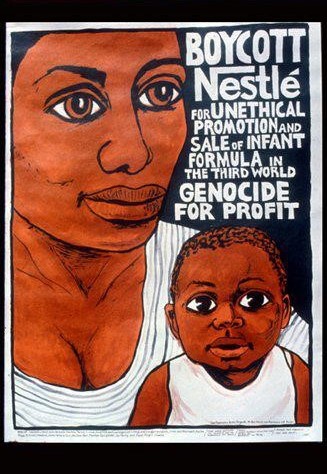
The first problem occurs due to water sanitation. Because this ad targeted to poor people, especially in Africa, they did not have any access to clean water. “UNICEF estimates that a formula-fed child living in disease-ridden and unhygienic conditions is between 6 and 25 times more likely to die of diarrhea and four times more likely to die of pneumonia than a breastfed child” (Andrei, 2016). Additionally, mothers tended to use less formula than needed due to low literacy rate. As a result, children got inadequate amount, which damaged their health. So such situation glue on the brand name as a bad reputation, and it is hard to make people forget.
Opportunity: Nestle always tries to catch today’s trends in many aspect that creates opportunities for it. First one is growth in online retail that creates new distribution channel which means stronger supply chain. Amazon Prime is one of the example. Another aspect is Nestle has adapted lifestyle changes such as longer working hours, faster life, single households or women in workforce lead people to prepacked foods. Hence, this kind of changed creates opportunities for Nestle. Third opportunity of the Nestle is having strong strategic alliances with other brands. Well-known one is Nestea, which is trademarked by Nestle and distributed by Coco-Cola. This relation is called as Co-Operation. “Being late entrants in the iced tea beverage industry, Nestlé and Coca-Cola decided to unite against Unilever’s market leading Lipton brand. As a result, both company get benefit from this strategic alliance” (Schee, Aurand et al., 2011, p.36). Furthermore, Nestle has many joint venture relations in different countries. These show “Nestlé’s reach into developing markets is enhanced by a brand alliance with an established company in the new market segment” (Schee, Aurand et al., 2011, p.37).
Threat: Drinks are one of the biggest product group of Nestle, almost %25 of total sales. Bottled water products alone generate 8% of the total company’s revenue (Nestle, 2015). So water is important input for Nestle; however, water is scarce due to climate change and increasing population. So, this will be a threat for Nestle. Another threat is flaming competition in food and beverage markets which consist of numerous small, large and multinational well-known companies which spread all over the world. The demand is increasing due to increasing wealth of people and population. Market has huge potential for profit however competition is the one main threat for all companies. Another issue is price of the raw material. While the countries develop, the raw materials provided from these countries will be increase. Nestle will be affected this as rise in their production cost. Last threat is trend of healthy food. Due to diabetics, obesity and many other illness spread, people tend to prefer healthier food. This trend may lead a threat for Nestlé’s prepackage products.
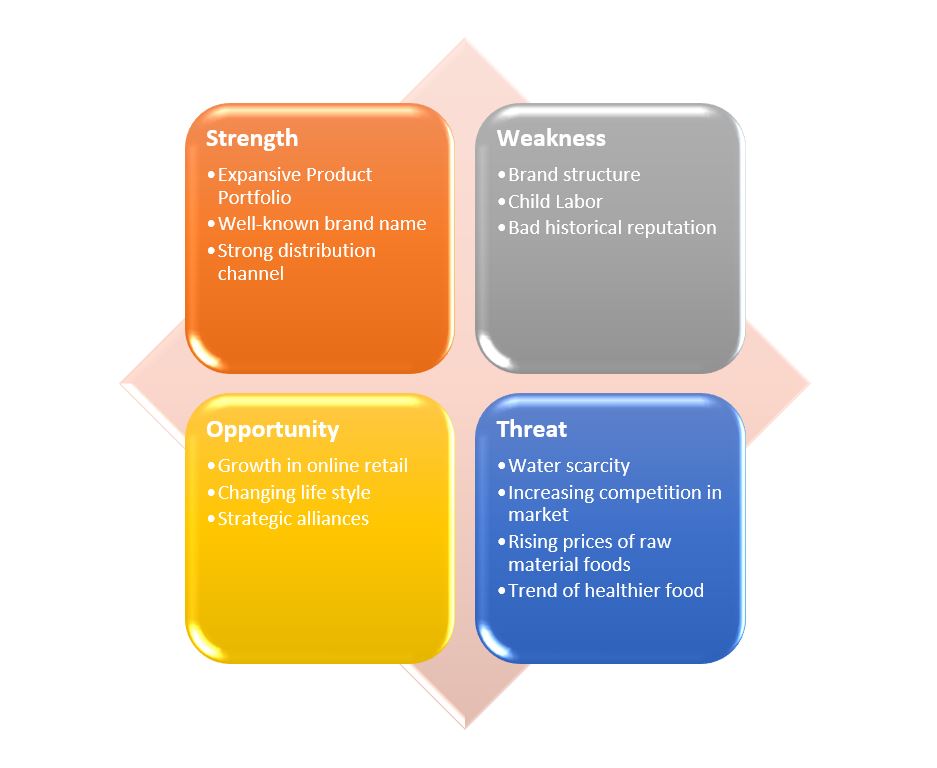
To sum up, following diagram shows the SWOT Analysis of Nestle. As a result, we can say that Nestle would be face with some threats due to its weaknesses and other factors; it has great strengths and opportunities to overcome these problems.
KITKAT
Strength: The most important strength of KitKat is being a product of Nestle, which is one of the biggest food company in the world. KitKat benefits from the wide familiarity of Nestle, so it is trusted for using good quality chocolate and taste. Furthermore, Nestle has developed and wide distribution channels all over the world, so it is easy to reach and it is generally available in all places thanks to Nestle’s supply chain. Another strength is its properties like its shape. It is different from many chocolate so it differentiate itself, in other words it is innovative product. Price can be mentioned as its strength because it is not too much when we compare with others, so its targeted population is very wide; younger to elder and low-income to high-income people. Its slogan is “Have a break, have a KitKat” which focuses on fast and stressful lifestyle of the today’s people which is common point of many people regardless of country, so this also supports that it targets all people.
Weakness: KitKat may be a package food; however, it has also shelf life, which is 1 year. This is a constraint for KitKat, it cannot store for a long time. Another weakness is their package, which does not change much due to protect its original way. However, changing package can enable them to reach new customer, and adapt the cultural differences in terms of colors. New flavor can be their weakness. Because if the taste is not very well and appeal to many people, then it leads a decrease of KitKat sales. For example KitKat Chunky Caramel flavor launched, after a while it disappeared. Such situation, decrease the tasty and qualified view of KitKat in the eyes of its customers.
Opportunity: Food industry is always growing due to population increase. The demand always increases, however new entrants face with difficulties due to huge brands. Nestle has its own loyal customer, which creates an opportunities for KitKat as well. Rural markets have great potential for KitKat, because of Nestle’s good distribution services. Different from other brands, KitKat has opportunity due to its parent company. Nestle has spread over and have marketing activities at many countries; so that KitKat can be reach all these countries and by using Nestle’s distribution channel, it has opportunity to spread more.
Threat: Sweet is a good substitute for chocolate, and there are many options for brand and species. There are various many other brands in the market, which is a threat for KitKat, and it is hard to survive under this conditions. Addition to this, other brands decrease their price level while they build production plant in these countries, which is another threat for KitKat. Because the price of raw material such as cacao bean increase so, that leads that price of KitKat needs to be increase to protect profit level. Other than that, there are imitation of the KitKat, which are less qualified and less tasty. This situation would cause to damage KitKat vision and reputation.

References
Andrei, M. (2016). “Why Nestle is one of the most hated companies in the world”. Retrieved from http://www.zmescience.com/science/nestle-company-pollution-children/.
Nestle (2017). Annual report 2015. Retrieved from http://www.nestle.com/assetlibrary/documents/library/documents/annual_reports/2015-annual-review-en.pdf
Nestle Official Website (2017), Retrieved from: http://www.nestle.com.eg/en/randd.
Schee, B.A.V., Aurand, T.W, et al. (2011). “Nestle:Brand Alliances in Developing Markets”, Journal for Advancement of Marketing Education, Vol.18, p.32-38.
 Sinem Atılgan Uşaklı
Analiz ve katkılarınız için teşekkürler,
BeğenLiked by 2 people